
Edtech
Building one connected education ecosystem across every stakeholder.
Managing engagement, reporting and program delivery across schools becomes increasingly complex when systems operate independently. Edtech needed a unified digital ecosystem capable of supporting thousands of users across multiple stakeholder groups.
The objective was not simply to digitise processes, but to create one scalable platform where schools, teachers, students and parents could interact, communicate and collaborate seamlessly.
Who is Edtech?
Edtech is an education-focused organisation supporting large-scale programs delivered across more than 1,000 schools. The initiative works across multiple stakeholder groups, including administrators, educators, students and parents, requiring a system capable of managing engagement, communication, reporting and program delivery at scale.
While individual portals and applications already existed, they operated in isolation, creating inefficiencies and limiting visibility across the broader ecosystem.
To support future growth, Edtech required a unified digital infrastructure capable of connecting every user role, standardising workflows and providing real-time access to the information needed for effective decision-making.
01
The Problem
1,000+ schools. Zero connected infrastructure.
The organisation had grown significantly, but its systems had not evolved at the same pace. Multiple portals, applications and manual processes existed across different stakeholder groups, creating operational silos and inconsistent user experiences.
Administrators lacked real-time visibility into engagement and performance, educators faced fragmented workflows and communication channels, while students and parents interacted with disconnected systems. The result was inefficiency, duplicated effort and limited oversight.
To scale effectively, the organisation needed a single digital ecosystem capable of bringing all users, processes and data together in one connected environment.

Schools
Schools lacked a unified platform to monitor engagement, participation, reporting and program performance across multiple user groups and locations.

Teachers
Educators relied on fragmented systems that increased administrative workload and limited access to real-time information and communication tools.

Students
Students engaged with disconnected processes that reduced accessibility, visibility and consistency throughout their learning and participation journeys.

Parents
Parents had limited visibility into program participation, communications and updates, reducing engagement and overall involvement.
02
Goals
Secure multi-role access. Structured programs. Real-time visibility.
The goal was to create a secure, scalable ecosystem capable of supporting every stakeholder on a single platform. Access needed to be role-specific, workflows standardised and reporting available in real time. The solution also had to support continual growth while maintaining operational efficiency, user security and a consistent experience across all schools and user groups.
Scalable Architecture Supporting 1,000+ Schools Without Structural Redesign
Create an infrastructure capable of accommodating growth while maintaining performance, stability and operational effectiveness.
Secure Multi-Role Access Across Schools, Teachers, Students, and Parents
Develop a role-based system where each user group could securely access relevant information, tools and workflows without compromising platform integrity.
Real-Time Dashboards for Engagement, Survey, Culture, and Incident Tracking
Provide administrators and stakeholders with immediate access to meaningful data, enabling faster decisions and improved visibility across programs.
03
Research
Mapping the existing ecosystem. Finding where it broke.
Before designing the solution, we analysed the existing digital environment to understand how data, users and workflows moved through the organisation. The research identified multiple points of friction caused by disconnected systems and manual processes.
Understanding these breakdowns allowed us to determine where consolidation, automation and standardisation would create the greatest operational impact while ensuring future scalability.
Ecosystem Analysis
Multiple portals and tools performed similar functions but lacked integration, resulting in duplicated effort, inconsistent reporting and limited visibility.
Stakeholder Dependency
Every user group depended upon information created by another group, making seamless system connectivity essential for operational success.
Where the disconnection was creating the most operational damage
The greatest operational challenges emerged wherever information needed to move between departments, schools or stakeholder groups. Data often existed in separate systems, requiring manual updates and creating inconsistencies across reporting processes. Engagement tracking, incident management, surveys and communication workflows all suffered from fragmentation. Administrative teams lacked a single source of truth, while users often experienced duplicated processes and unnecessary complexity. These inefficiencies not only increased workload but also reduced visibility into program performance. Without integration, scaling operations across growing numbers of schools would continue becoming increasingly difficult.
What administrative teams and educators needed most from a unified system
Administrators required real-time oversight, accurate reporting and the ability to monitor participation across all schools from a centralised environment. Teachers needed simplified workflows, streamlined communication tools and easier access to student information. Both groups wanted fewer manual processes and better visibility into programme outcomes. The research showed that efficiency improvements were only possible through consolidation. A unified platform would reduce administrative burden while providing greater clarity, consistency and accountability across the entire education ecosystem.

Ecompapi's Strategic Insight
The challenge wasn't building another portal. The challenge was eliminating the need for multiple disconnected systems altogether. Creating separate solutions for each user group would only add complexity. The real opportunity was to create one connected ecosystem where schools, teachers, students and parents could interact through a shared infrastructure. Once systems, workflows and reporting were unified, operational efficiency and visibility would improve simultaneously.
04
Our Strategy
Unify systems. Don't add layers.
Rather than introducing additional software or standalone applications, our strategy focused on consolidation. We created a unified architecture designed around connected workflows, role-based permissions and centralised reporting. Every feature, process and user interaction was mapped into one scalable ecosystem, ensuring that growth could be supported without increasing complexity or operational overhead.


Connected Architecture Replacing Fragmented Portals
A single platform replaced isolated portals, creating seamless access to information, workflows and communication across all stakeholder groups.

Role-Based Access with Defined Permissions for All 4 User Types
Permission structures ensured every user received access to the tools and information relevant to their specific responsibilities and requirements.

Real-Time Reporting Infrastructure Replacing Manual Data Aggregation
Automated reporting eliminated time-consuming manual consolidation while providing faster, more accurate access to critical operational data.

Scalable Platform Architecture Designed for Long-Term Growth
The infrastructure was engineered to support future expansion across users, schools and programmes without requiring major redevelopment.

05
Execution
One platform. Every role. Real-time. Scalable.
Execution focused on transforming fragmented systems into one cohesive digital ecosystem. Web portals, mobile applications, reporting frameworks and communication systems were unified under a single architecture. Every capability was designed around scalability, security and operational simplicity, ensuring the platform could support future growth while delivering immediate value to all stakeholder groups.

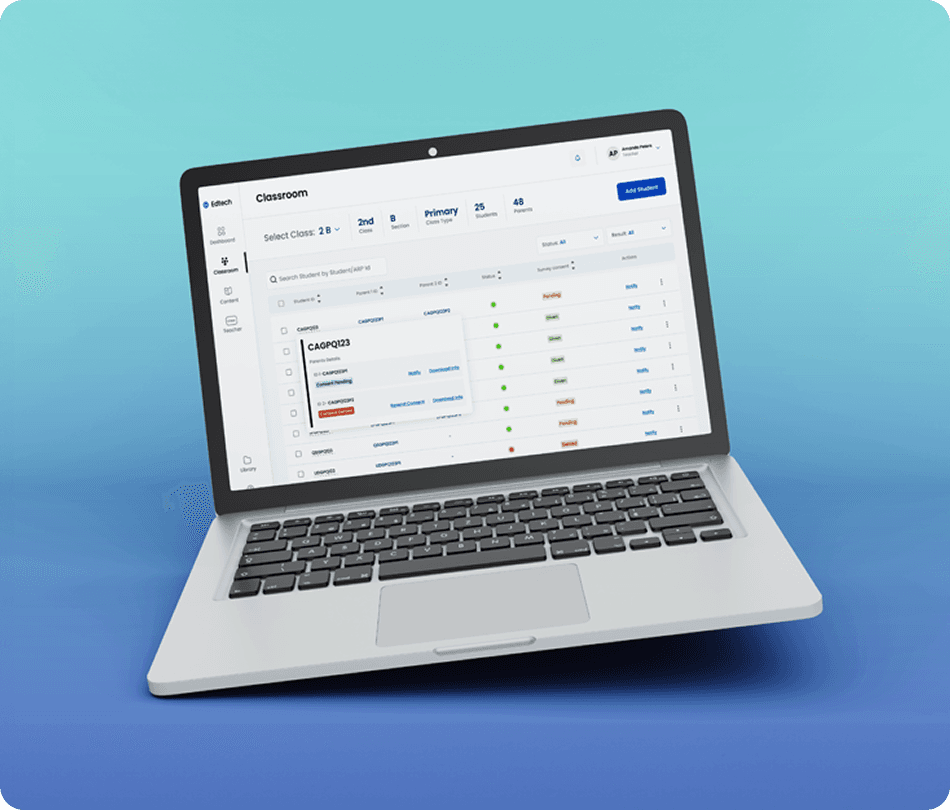

Role-Based Access System
Developed permission-driven access controls that delivered secure, role-specific experiences for all user categories.

Unified Web Portals
Consolidated multiple systems into connected web portals, reducing complexity and improving consistency across workflows.

Mobile Application
Implemented a mobile experience that extended platform accessibility while supporting engagement and communication.

Real-Time Dashboards
Built reporting dashboards that provided immediate visibility into engagement, surveys, incidents and programme performance.

Onboarding Automation
Automated onboarding processes reduced administrative workload and streamlined user setup across the platform.

Secure Communication Channels
Integrated communication tools enabled consistent and secure interactions between stakeholders throughout the ecosystem.

Program Workflow Standardisation
Created structured workflows that improved consistency, accountability and operational efficiency across all participating schools.
Scalable Infrastructure
Implemented a scalable technical foundation capable of supporting thousands of users and continued organisational growth.
06
Results
Fragmented processes to unified, scalable digital infrastructure.

All stakeholder groups now operate within one connected ecosystem while maintaining secure, role-specific access and workflows.
Previously disconnected systems were consolidated into a single digital environment, improving visibility, collaboration and operational efficiency.
The platform architecture now supports large-scale programme delivery without requiring structural redesign or significant operational changes.

Operational Outcomes
The project delivered more than a technology upgrade. It transformed how information, communication and workflows moved across the organisation. Administrative teams gained access to real-time reporting and improved oversight. Educators benefited from simplified processes and greater visibility into programme activity. Students and parents experienced more consistent engagement and communication. By consolidating systems into one platform, the organisation reduced inefficiencies, improved accountability and created a stronger foundation for future growth. Most importantly, the ecosystem now supports scale without sacrificing usability, security or operational control.
What this proves
Large-scale educational programmes don't fail because of a lack of technology. They fail because technology often exists in isolated systems that don't communicate effectively. This project demonstrates that sustainable digital transformation comes from integration rather than addition. By connecting users, workflows and data within one ecosystem, organisations gain greater visibility, stronger operational control and improved user experiences. A unified infrastructure reduces complexity while creating new opportunities for scalability and growth. For Edtech, success wasn't building more platforms. It was building one platform capable of supporting everyone.
What our clients have to say
The best way to understand how we work is through the people we've worked with. Hear their stories, experiences and the impact we've created together.
Other Case Studies


Cella Architects
Ecompapi collaborated with Cella Architects to enhance its digital presence and engage its audience through thoughtful design and content. Our UI/UX professionals created interfaces that ensured ...


Sabco Electricals
Lorem ipsum dolor sit amet, consectetur adipiscing elit. Sed do eiusmod tempor incididunt ut labore et dolore magna aliqua. Lorem ipsum dolor sit amet, consectetur adipiscing elit